Archive for June, 2011

Minuteman group talked of shutting down Arizona freeway

By Nick R. Martin | Tuesday, June 28th, 2011 | 12:20 am | View Comments
Read the leaked memo
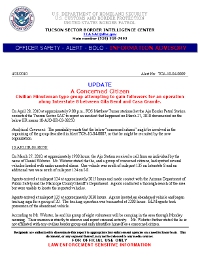
This U.S. Border Patrol memo leaked by hacker group LulzSec says a Minuteman group talked about shutting down a stretch of Arizona freeway in 2010.
Click for two-page PDF.

U.S. Border Patrol memo leaked by LulzSec

Federal agents were warned last year that a Minuteman group was planning to shut down a large section of freeway in central Arizona in an attempt to catch smugglers crossing through the desert, according to a secret law enforcement memo leaked last week.

The April 28, 2010 memo said the U.S. Border Patrol had received information that the group, which went by the name “A Concerned Citizen,” was recruiting people to help it shut down part or all of a 30-mile stretch of Interstate 8 between Casa Grande and Gila Bend.

The group reportedly wanted to carry out the operation to show support for Arizona’s strict new immigration law, known as SB1070, which had been signed by Gov. Jan Brewer five days prior.

The document didn’t say where the Border Patrol got its information, but it was clear the agency was worried about the development. It said the “tone of this information is quite unlike” that of better-publicized operations by Minuteman groups that had patrolled the borderlands.

“If this new operation happens,” the memo said, “there could be potential for human rights violations and a possibility of violence between armed civilians and smugglers or with law enforcement.”
Leaked memo shows Border Patrol found roadside bomb along smuggling route

By Nick R. Martin | Monday, June 27th, 2011 | 12:14 am | View Comments

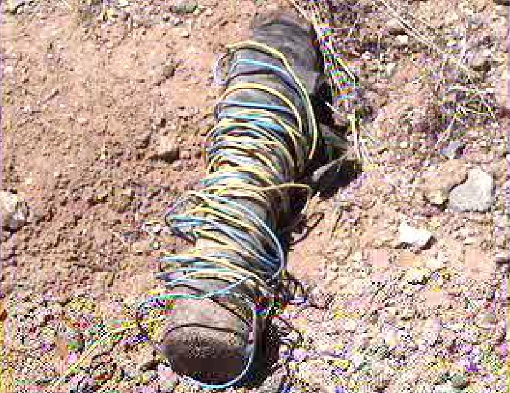
Roadside bomb found by a US Border Patrol agent
Documents leaked by hacker group LulzSec reveal a U.S. Border Patrol agent discovered a roadside bomb planted along a smuggling route west of Tucson in 2009.

Read the leaked memo
This memo, leaked by hacker group LulzSec, reveals the U.S. Border Patrol discovered a roadside bomb along an Arizona smuggling route in 2009.

Click for two-page PDF.

Pima County Sheriff's Department memo leaked by LulzSec

A U.S. Border Patrol agent discovered a roadside bomb planted in the dirt along a known smuggling route west of Tucson in 2009, according to a secret memo leaked during last week’s hacking of Arizona Department of Public Safety email accounts.

The May 2009 memo, written by the Pima County Sheriff’s Department bomb squad and marked “not for public or media dissemination,” said the explosive detonated during the subsequent investigation. The document didn’t say whether anyone was hurt in the explosion.

The memo said the device appeared to be “moderately complex” in its construction. It was made out of pipe and wrapped in wires.

It was unclear to investigators at the time who planted the bomb or why. Law enforcement officers patrolling the area were told to be extra careful and to look out for similar devices. The investigation was handed off to the federal Bureau of Alcohol, Tobacco, Firearms and Explosives as well as the FBI.

Is Arizona ready for the next hack?

By Nick R. Martin | Sunday, June 26th, 2011 | 6:57 pm | View Comments
Read the leaked memo
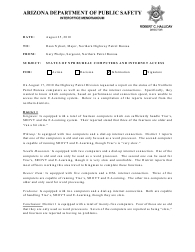
In this memo, leaked by hacker group LulzSec, an Arizona DPS sergeant details poor computers at some of the agency’s offices.

Click for four-page PDF.

Arizona Department of Public Safety memo leaked by LulzSec

Arizona’s state police force, the Department of Public Safety, went into something of a panic on Thursday night after a group of brazen hackers broke into the email accounts of a handful of officers and leaked secret law enforcement documents to the world.

The agency shut down its own website, froze parts of its email system and launched an investigation to try to figure out how bad the breach was and how it happened.

Yet in all the posturing and fist-pounding state officials did in the hours that followed, the question of whether Arizona has a strategy to deal with future attacks seemed to be lost in the noise.

Instead, the focus was on the seven officers, some of whom had their names, home addresses, cell phone numbers, passwords and personal financial information posted on the internet.